
BlogSeasonal Guide· Transfer & Car Rental
AntRay tram lines: where to where, how many stops?
FindAntalya Guide TeamJuly 24, 20267 min read
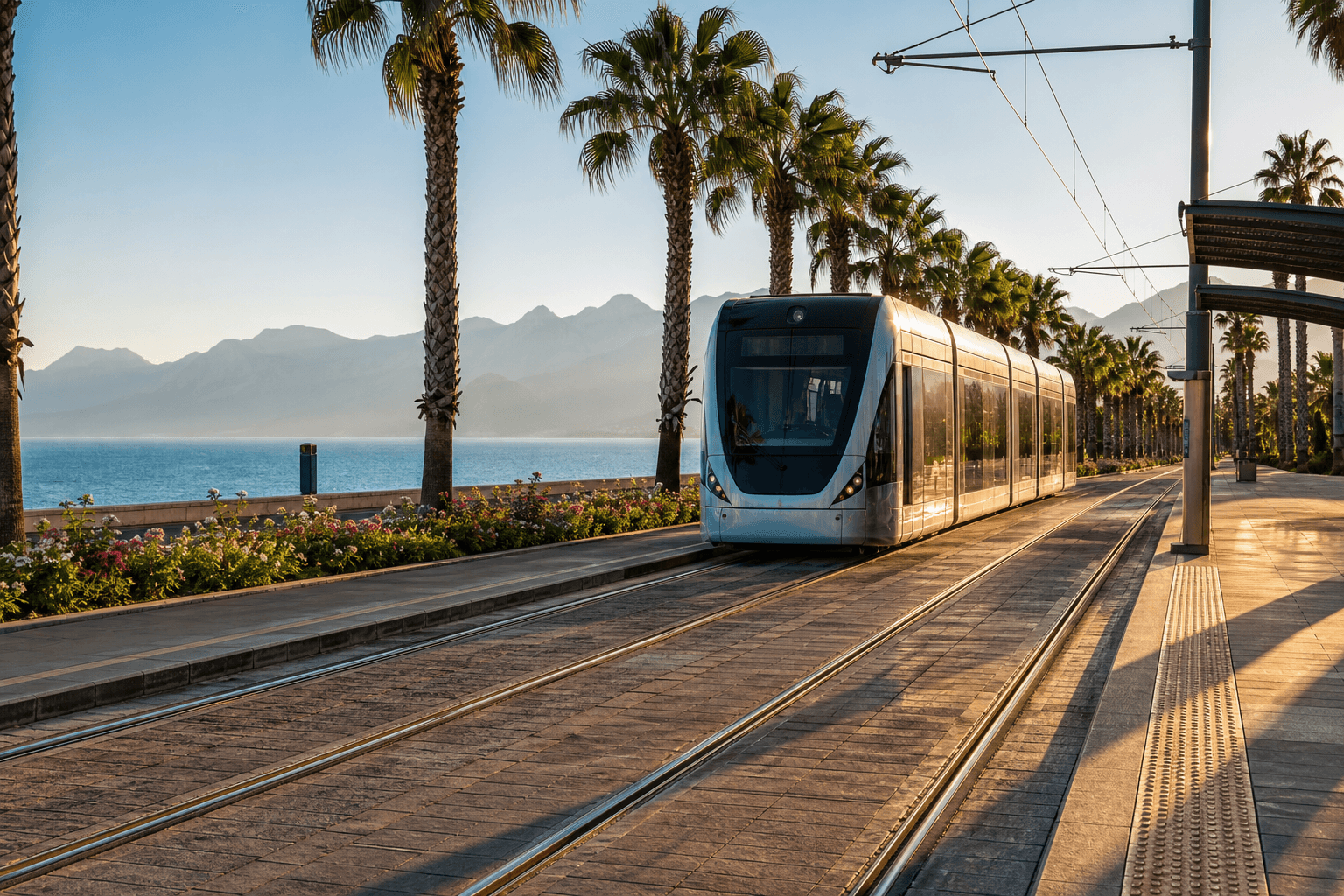
The most realistic way to get around by tram in Antalya
In Antalya, the tram is one of the most practical backbones of city transport. Especially in summer, when traffic clogs up along the coastal road and the main arteries, the order offered by the tracks makes people feel at ease. But there’s a trade-off for that comfort: in July and August, around midday the platforms, outdoor stops, and pedestrian crossings heat up seriously. When the sun is overhead, even a short distance can create the feeling of “let me stop for a moment and catch my breath.” Still, the tram remains one of the easiest ways—both for locals and visitors—to understand Antalya. Because the lines don’t just take you from one point to another; they also show you the rhythm of the city center, the movement along the seafront strip, and the layout of new residential areas.
When it comes to AntRay, we’re really talking about a few different line structures. You can read the system used in the city through the modern line that connects the airport and the southern axis, as well as the rail lines that run in an east–west direction from the center. In this piece, what matters is the logic of the route more than the numbers: where it goes from and to, which areas it connects, roughly how many stops it covers, and in which hours it’s quieter. Since the number of stops and operating details can change over time, it’s smart to check the latest service information before you set out.

Which line goes where?
When using the tram in Antalya, the first distinction is between the line that circles the city center and the line that reaches further out areas and transport hubs. The center line keeps together the areas with the busiest pedestrian movement, the surroundings of official institutions, residential zones, and the connections opening toward the seafront. This line is especially suitable for short- and medium-distance trips during daytime. When shop shutters open, cafés start getting busier in the afternoon, and crowd levels rise during school dismissal times and at the end of the workday, the tram cars noticeably fill up.
Another key use is access to the airport and the transport points around it. For passengers flying, the tram is a serious advantage if your luggage is light. On days when taxi prices can rise and people prefer to move a few stops around the city without renting a car, the tram works. Especially in summer, even seeing the road traffic near the airport from the outside makes public transport seem reasonable. But if the suitcase is big, if you’re traveling with children, or if standing in the midday heat is hard, the same journey can feel quite exhausting.
Some parts of the lines reach residential areas at their end stops, and some reach points in the center where you can transfer. That’s why using the tram in Antalya is also a matter of asking yourself: “Which neighborhood are you willing to get off in and walk from?” The city may seem compact, but even a few hundred meters of extra walking in summer heat can change your plans. The effect is especially clear in areas with lots of open space and little shade.
How many stops, and how long?
For AntRay, the number of stops depends on which line you choose. On lines that pass through the center, stops are set up close to each other, so you get a flow that feels a bit like a metro over short distances—meaning you change neighborhood with just one or two stops. On the sections stretching toward the airport and the outer axis, the journey becomes a little more spread out, and the city opens up wider. This makes Antalya’s geography easier to read: dense city center on one side, planned new areas on the other, and everyday life stretching along the main roads in between.
Rather than memorizing the number of stops, it’s healthier to think about the journey by regions. For example, to go from around the center to a point near the seafront side, you might need only a few stops. On the segment that goes to the airport, meanwhile, the duration depends more on the day’s traffic and how easy it is to reach the station than on the stop count. In the early morning hours, the trip may flow more smoothly; in the late afternoon, tram cars get more crowded due to return trips from tourism, people leaving work, and transfer traffic.
During this period, the most striking feature of tram travel in Antalya is that the weather directly determines comfort. In winter the system is used much more comfortably; waiting at a stop on cool but not harsh days isn’t a problem, and walking around in the city center can be enjoyable too. Even in November, when the sea may still pull people in at some hours, getting off at stops along the seafront axis offers a calmer, more spacious experience. In summer, however, the same route sometimes turns into a test of standing around with little or no shade.
In which season is it more comfortable?
In Antalya, the most comfortable periods for the tram are usually spring and the early part of autumn. In March, April, and May, when the weather hasn’t become suffocating yet, the city starts moving; walking on the seafront side, getting off the tram, and plotting a short route becomes easier. October and November also bring similar comfort. The sea can still feel appealing until early October; getting off at stops near the seafront and walking to the bazaar (çarşı), parks, or the central axis feels better during this time.
In the middle of summer, the picture changes. In August, even if the inside of the car is air-conditioned, it can be tiring just to reach the stop—those few minutes are enough. Antalya’s humidity can feel heavy on some days; even in the shade the air still feels hot. So if you’re planning a long day in the city, it makes more sense to use the tram early in the morning or in the late afternoon. In the middle of the day, if possible, reducing the number of transfers and timing short walks so they fall in the shade is a good idea.
In winter, it’s the opposite: there’s a calmer feeling. Crowds along the seaside lessen, some shopkeepers work more comfortably, and walking paths empty out. The chance of finding a place to sit on the tram increases. When the pace in the city slows down, the lines’ function becomes clearer: not just a transport vehicle, but a regular line-like order that ties the city together.
Is it time to go now?
Short answer: yes—but by choosing the right hours. In Antalya, the period that makes the tram experience most efficient is autumn, when extreme heat eases, and mild spring months. In these months, waiting at stops is easier and it’s more enjoyable to get off and explore the surroundings. Summer can also be used; it’s even one of the smartest options in many cases for moving quickly within the city center. But if you’re thinking of standing around at noon in August—especially at stops without much shade—you’ll need to be ready for that.
If your goal is to get to know Antalya via rails, the tram is a good starting point. Thanks to the airport connection, the short hops in the center, and the transitions that stretch toward the seafront side, you can catch the city’s daily flow. Just keep one reality in mind: in Antalya, your public-transport plan is thought of more with the weather than with the map. If the sun is harsh, the route gets shorter; if the weather is mild, the tram reveals a more comfortable side of the city.
In the end, AntRay gives you a quick answer to “Where can I go from where?”—but it also makes you look for an answer to “Which time is more tolerable?” In the right season, at the right time, it’s one of the city’s most hassle-free transport options. At the wrong time, it can turn into an open-air stop that reminds you of Antalya’s summer reality.
For up-to-date business information and reviews about the places mentioned in this article, take a look at the FindAntalya transfer & car rental list.
Featured with FindAntalya
Build your whole Antalya trip in one place
Flights, transfers, tours, hotels, insurance — find the best deal with FindAntalya-approved partners.

Airport transfer
Meet & greet, fixed price to your hotel
See prices
Car rental
Local suppliers, airport pickup
See prices
Tours & activities
Boat, safari, diving, day trips
See prices
Museum & attraction tickets
Aspendos, aquarium, theme parks — mobile ticket
See prices
Tourist eSIM / data
Get online the moment you land
See prices
Travel insurance
Policy in minutes, peace of mind
See prices
Hotels & stays
Compare by area, find the best deal
See pricesPartner links; booking and payment are completed at the provider. Prices come from the provider.