Getting Around Antalya in November: The Season Is Calm, the City Is Still Moving
FindAntalya Guide TeamJuly 2, 20266 min read
First thing in Antalya in November: getting from arrival into the city
When you come to Antalya in November, the most practical start is to figure out in advance how you’ll get from the airport to the city center. The summer crowds ease off; even so, if your arrival time falls in the late afternoon, public transport and travel-time planning become important.
The first step, after picking up your suitcase, is to decide which method suits you for getting around the city. One of the easiest options is the rail system connection or public-transport transfers around the airport. If you want to be quick, the only goal is to reach a central point; from there, you’ll head to your neighborhood by tram, bus, or a short dolmuş (shared minibus) ride.

A common misunderstanding is this: people assume you can get from the airport everywhere by one vehicle, nonstop and in a short time. In Antalya, that may be possible at certain hours; but the best approach is to first get onto the city’s central spine, then spread out into the neighborhood. Thinking of it that way makes the journey clearer.
If on your first day you want to get quickly to your hotel or the area where you’re staying, the logic below will help:
- From the airport, first reach a central transfer point.
- From there, use the tram line or the main bus lines.
- For the last kilometer, plan a dolmuş or a short walk.
This setup is especially useful in November; traffic is not as congested as in summer, but because the city is spread out, expecting a “one-shot arrival” can still be misleading.
Tram and dolmuş logic: which one in which case?
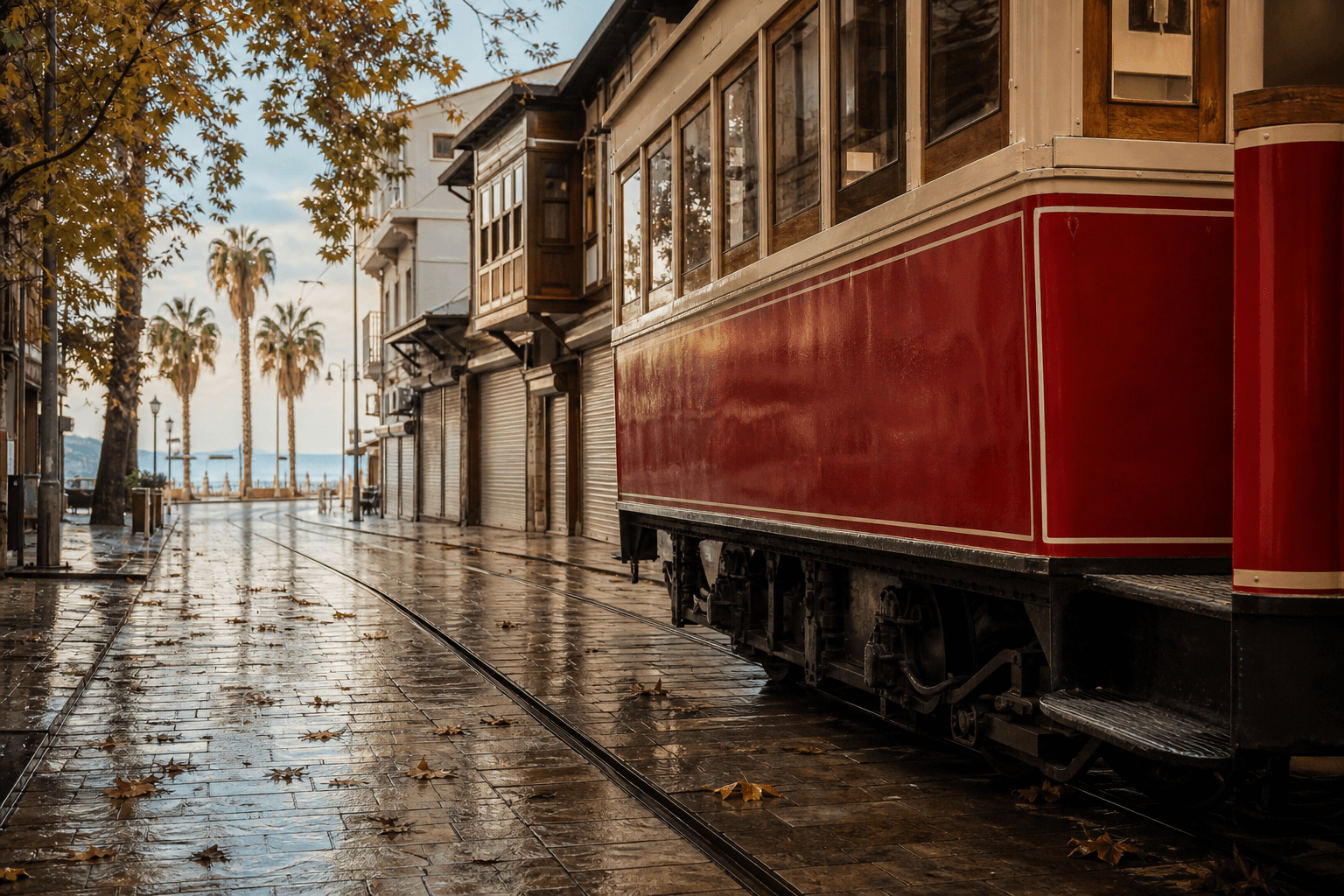
The easiest way to understand city transport in Antalya is to think of the tram as the backbone and the dolmuş as a short connection tool. If you match these two correctly, you can get around comfortably without renting a car.
The tram is suitable for broader, more predictable transfers. It especially helps with finding your bearings as you move along the main central lines. If you’re going from one area to another for the first time, the tram becomes your reference. After getting off, you reach your destination with a short walk or a quick transfer.
The dolmuş, on the other hand, is more local, stops more often, and is more flexible. It has advantages for short-distance moves, when you’re heading to intermediate areas that the tram doesn’t reach directly, or when you need to make a quick crossing between two neighborhoods. But what you need to keep in mind here is this: the dolmuş does not solve every problem in the city; it only saves time if used on the right route.
The most common misconception is thinking the dolmuş is always faster than the tram. That is not true. Outside peak hours it can be fast over short distances; but on main arteries, the tram is often more predictable. Conversely, people think the tram goes everywhere; that’s not true either. In many places, you need the dolmuş for the final connection.
How do you choose?
- Long distance and central connection: tram.
- Short neighborhood crossing and final-stop connection: dolmuş.
- If you’re unsure, get onto the main line first, then narrow down.
Since the weather is cooler in November, walking has an extra advantage too. Getting off one stop early and walking a short route makes distances that could be challenging in the summer heat much more comfortable.
The most practical way when moving from one district to another
Even though Antalya’s districts may look close to one another, in daily transport the sense of distance can be misleading. A crossing that looks short on the map can become transfer-based in public-transport routing. So you shouldn’t treat “near” and “easy” as the same thing.
How should you think about it? First, identify the main exit point of the area you’re in. Then check which transport artery the destination area is close to. If the two areas are not on the same main line, making a transfer in the center is more sensible than trying to go directly.
For example, if you’re staying around the center, moving between the seaside side and the inner parts is usually easy; but it may not always be short enough to finish on foot. A move toward the Konyaaltı side does not work with the same logic as a move toward the Lara side. One is coast-oriented, the other is broader and relies on different connection options. That’s why you need to understand the district structure first.
When moving from one district to another, use this order:
1. Find the main line closest to you.
2. Learn which central point that line takes you to.
3. Plan the short connection from the last stop to the target district.
4. On the way back, think separately about nighttime hours; don’t expect the same service frequency every day.
A common mistake is assuming, “I’m in the city center, everywhere is walkable.” That may be partly true for short tourist strolls; but even in November, Antalya is a large city. When moving from one district to another, it’s better to base your plan on smart transfers rather than walking.
Getting around without renting a car: when it makes sense, when it’s unnecessary
In November, exploring Antalya without renting a car is possible for most visitors. Because the main focus of city movement is the coastal line, center connections, and selected districts. This structure is comfortably handled with a combination of public transport + short walks + dolmuş when needed.
The biggest advantage of not renting a car is not dealing with parking and navigation stress. Especially in the city center, near the coast, and in busy areas, driving can slow your trip down instead of speeding it up. Even though traffic is not as heavy as in summer in November, the confusion of directions still remains.
The situations where you truly might need to rent a car are these:
- If you’ll be visiting several different points outside the city on the same day.
- If you’ll be returning very late at times when public transport is infrequent.
- If you’ll be going to farther surrounding districts on your own schedule.
For most other city plans, a car is not necessary. In fact, sometimes not renting a car makes your route simpler. Breakfast in one area in the morning, wandering around the center at midday, and an evening walk by the sea all work more comfortably by public transport.
Let’s make one important correction here: the idea that “November has arrived, the city has emptied out, everything is easy at any time I want” is not entirely true. Yes, the crowds shrink; but the lines still require planning. Especially for first-time visitors, the best strategy is to build a short and clear transport plan.
In short, for a car-free trip this is enough:
- Choose accommodation close to the main lines.
- When planning your day route, don’t change neighborhoods too many times in one day.
- Don’t leave your return trip to the late evening.
- Check the current line and service information before you go.
In November, Antalya doesn’t stop; it just changes tempo. That’s why transport should be organized not with a summer plan, but with a calmer and smarter setup.
You can review neighborhood-by-neighborhood transport and sightseeing routes on FindAntalya and simplify your own plan accordingly.
For up-to-date business information and reviews about the places mentioned in this article, browse Antalya businesses on FindAntalya.
Featured with FindAntalya
Build your whole Antalya trip in one place
Flights, transfers, tours, hotels, insurance — find the best deal with FindAntalya-approved partners.

Airport transfer
Meet & greet, fixed price to your hotel
See prices
Car rental
Local suppliers, airport pickup
See prices
Tours & activities
Boat, safari, diving, day trips
See prices
Museum & attraction tickets
Aspendos, aquarium, theme parks — mobile ticket
See prices
Tourist eSIM / data
Get online the moment you land
See prices
Travel insurance
Policy in minutes, peace of mind
See prices
Hotels & stays
Compare by area, find the best deal
See pricesPartner links; booking and payment are completed at the provider. Prices come from the provider.